Reliable ACD-301 Exam Pdf - Detailed ACD-301 Study Plan
Wiki Article
BONUS!!! Download part of Lead1Pass ACD-301 dumps for free: https://drive.google.com/open?id=1Gi_L_kU2j-LEeU6_k1UgsELVKKmfzLbY
To assimilate those useful knowledge better, many customers eager to have some kinds of ACD-301 learning materials worth practicing. All content is clear and easily understood in our ACD-301 exam guide. They are accessible with reasonable prices and various versions for your option. All content are in compliance with regulations of the ACD-301 Exam. As long as you are determined to succeed, our ACD-301 study quiz will be your best reliance.
The price for Appian Certified Lead Developer ACD-301 study materials is quite reasonable, and no matter you are a student or you are an employee, you can afford the expense. Besides, Appian ACD-301 exam materials are compiled by skilled professionals, therefore quality can be guaranteed. ACD-301 Study Materials cover most knowledge points for the exam, and you can learn lots of professional knowledge in the process of trainning.
>> Reliable ACD-301 Exam Pdf <<
Free PDF ACD-301 - Marvelous Reliable Appian Certified Lead Developer Exam Pdf
Now you do not need to worry about the relevancy and top standard of Lead1Pass Appian Certified Lead Developer (ACD-301) exam questions. These Appian ACD-301 dumps are designed and verified by qualified ACD-301 exam trainers. Now you can trust Lead1Pass Appian ACD-301 Practice Questions and start preparation without wasting further time. With the ACD-301 exam questions you will get everything that you need to learn, prepare and pass the challenging ACD-301 exam with good scores.
Appian Certified Lead Developer Sample Questions (Q20-Q25):
NEW QUESTION # 20
A customer wants to integrate a CSV file once a day into their Appian application, sent every night at 1:00 AM. The file contains hundreds of thousands of items to be used daily by users as soon as their workday starts at 8:00 AM. Considering the high volume of data to manipulate and the nature of the operation, what is the best technical option to process the requirement?
- A. Create a set of stored procedures to handle the volume and the complexity of the expectations, and call it after each integration.
- B. Process what can be completed easily in a process model after each integration, and complete the most complex tasks using a set of stored procedures.
- C. Build a complex and optimized view (relevant indices, efficient joins, etc.), and use it every time a user needs to use the data.
- D. Use an Appian Process Model, initiated after every integration, to loop on each item and update it to the business requirements.
Answer: A
Explanation:
Comprehensive and Detailed In-Depth Explanation:
As an Appian Lead Developer, handling a daily CSV integration with hundreds of thousands of items requires a solution that balances performance, scalability, and Appian's architectural strengths. The timing (1:00 AM integration, 8:00 AM availability) and data volume necessitate efficient processing and minimal runtime overhead. Let's evaluate each option based on Appian's official documentation and best practices:
A . Use an Appian Process Model, initiated after every integration, to loop on each item and update it to the business requirements:
This approach involves parsing the CSV in a process model and using a looping mechanism (e.g., a subprocess or script task with fn!forEach) to process each item. While Appian process models are excellent for orchestrating workflows, they are not optimized for high-volume data processing. Looping over hundreds of thousands of records would strain the process engine, leading to timeouts, memory issues, or slow execution-potentially missing the 8:00 AM deadline. Appian's documentation warns against using process models for bulk data operations, recommending database-level processing instead. This is not a viable solution.
B . Build a complex and optimized view (relevant indices, efficient joins, etc.), and use it every time a user needs to use the data:
This suggests loading the CSV into a table and creating an optimized database view (e.g., with indices and joins) for user queries via a!queryEntity. While this improves read performance for users at 8:00 AM, it doesn't address the integration process itself. The question focuses on processing the CSV ("manipulate" and "operation"), not just querying. Building a view assumes the data is already loaded and transformed, leaving the heavy lifting of integration unaddressed. This option is incomplete and misaligned with the requirement's focus on processing efficiency.
C . Create a set of stored procedures to handle the volume and the complexity of the expectations, and call it after each integration:
This is the best choice. Stored procedures, executed in the database, are designed for high-volume data manipulation (e.g., parsing CSV, transforming data, and applying business logic). In this scenario, you can configure an Appian process model to trigger at 1:00 AM (using a timer event) after the CSV is received (e.g., via FTP or Appian's File System utilities), then call a stored procedure via the "Execute Stored Procedure" smart service. The stored procedure can efficiently bulk-load the CSV (e.g., using SQL's BULK INSERT or equivalent), process the data, and update tables-all within the database's optimized environment. This ensures completion by 8:00 AM and aligns with Appian's recommendation to offload complex, large-scale data operations to the database layer, maintaining Appian as the orchestration layer.
D . Process what can be completed easily in a process model after each integration, and complete the most complex tasks using a set of stored procedures:
This hybrid approach splits the workload: simple tasks (e.g., validation) in a process model, and complex tasks (e.g., transformations) in stored procedures. While this leverages Appian's strengths (orchestration) and database efficiency, it adds unnecessary complexity. Managing two layers of processing increases maintenance overhead and risks partial failures (e.g., process model timeouts before stored procedures run). Appian's best practices favor a single, cohesive approach for bulk data integration, making this less efficient than a pure stored procedure solution (C).
Conclusion: Creating a set of stored procedures (C) is the best option. It leverages the database's native capabilities to handle the high volume and complexity of the CSV integration, ensuring fast, reliable processing between 1:00 AM and 8:00 AM. Appian orchestrates the trigger and integration (e.g., via a process model), while the stored procedure performs the heavy lifting-aligning with Appian's performance guidelines for large-scale data operations.
Appian Documentation: "Execute Stored Procedure Smart Service" (Process Modeling > Smart Services).
Appian Lead Developer Certification: Data Integration Module (Handling Large Data Volumes).
Appian Best Practices: "Performance Considerations for Data Integration" (Database vs. Process Model Processing).
NEW QUESTION # 21
You are deciding the appropriate process model data management strategy.
For each requirement. match the appropriate strategies to implement. Each strategy will be used once.
Note: To change your responses, you may deselect your response by clicking the blank space at the top of the selection list.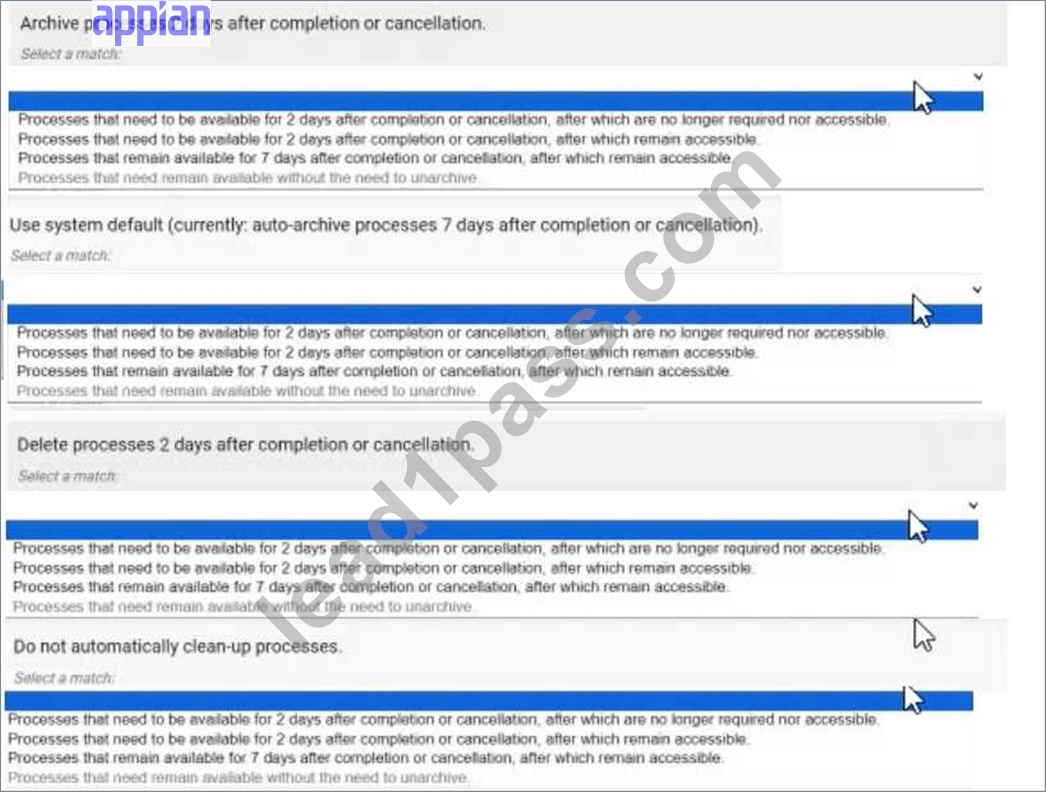
Answer:
Explanation: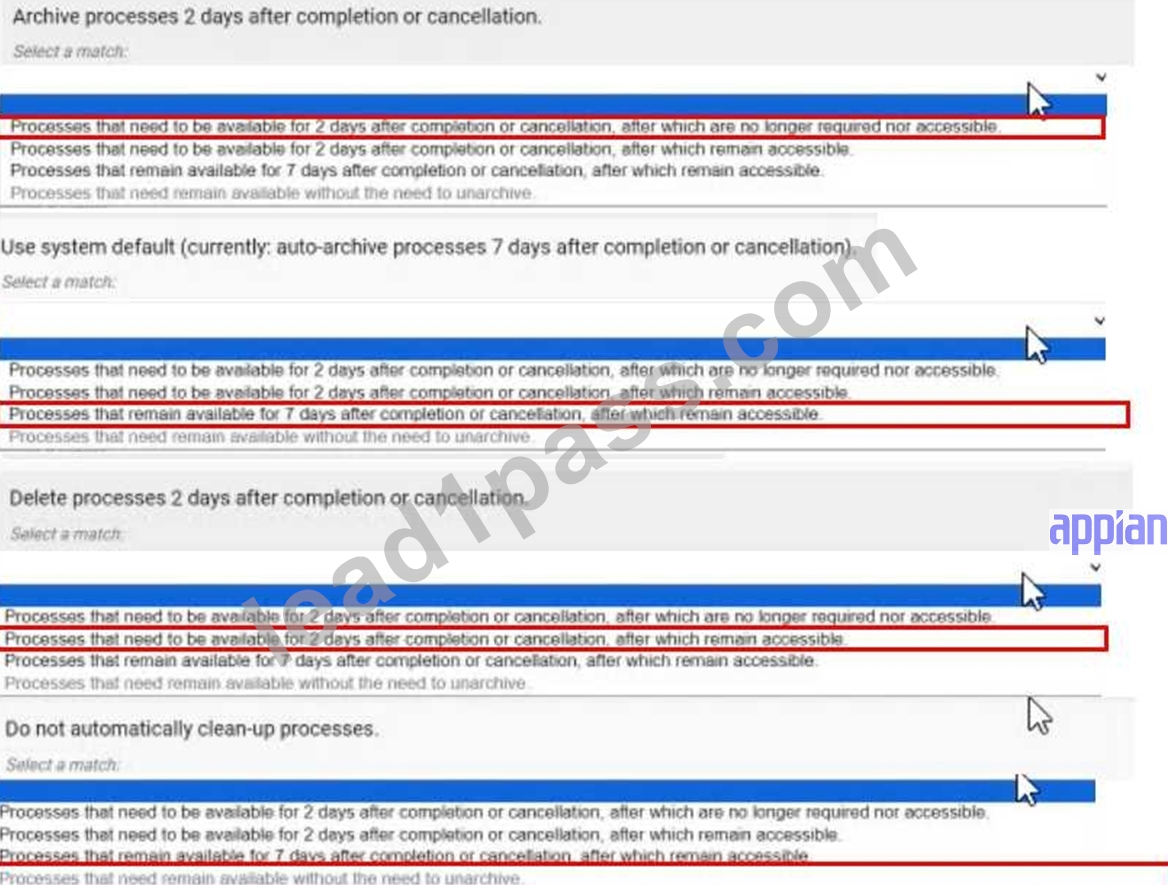
NEW QUESTION # 22
You have created a Web API in Appian with the following URL to call it: https://exampleappiancloud.com/suite/webapi/user_management/users?username=john.smith. Which is the correct syntax for referring to the username parameter?
- A. httpRequest.queryParameters.username
- B. httpRequest.queryParameters.users.username
- C. httpRequest.formData.username
- D. httpRequest.users.username
Answer: A
Explanation:
Comprehensive and Detailed In-Depth Explanation:
In Appian, when creating a Web API, parameters passed in the URL (e.g., query parameters) are accessed within the Web API expression using the httpRequest object. The URL https://exampleappiancloud.com/suite/webapi/user_management/users?username=john.smith includes a query parameter username with the value john.smith. Appian's Web API documentation specifies how to handle such parameters in the expression rule associated with the Web API.
Option D (httpRequest.queryParameters.username):
This is the correct syntax. The httpRequest.queryParameters object contains all query parameters from the URL. Since username is a single query parameter, you access it directly as httpRequest.queryParameters.username. This returns the value john.smith as a text string, which can then be used in the Web API logic (e.g., to query a user record). Appian's expression language treats query parameters as key-value pairs under queryParameters, making this the standard approach.
Option A (httpRequest.queryParameters.users.username):
This is incorrect. The users part suggests a nested structure (e.g., users as a parameter containing a username subfield), which does not match the URL. The URL only defines username as a top-level query parameter, not a nested object.
Option B (httpRequest.users.username):
This is invalid. The httpRequest object does not have a direct users property. Query parameters are accessed via queryParameters, and there's no indication of a users object in the URL or Appian's Web API model.
Option C (httpRequest.formData.username):
This is incorrect. The httpRequest.formData object is used for parameters passed in the body of a POST or PUT request (e.g., form submissions), not for query parameters in a GET request URL. Since the username is part of the query string (?username=john.smith), formData does not apply.
The correct syntax leverages Appian's standard handling of query parameters, ensuring the Web API can process the username value effectively.
NEW QUESTION # 23
While working on an application, you have identified oddities and breaks in some of your components. How can you guarantee that this mistake does not happen again in the future?
- A. Create a best practice that enforces a peer review of the deletion of any components within the application.
- B. Ensure that the application administrator group only has designers from that application's team.
- C. Provide Appian developers with the "Designer" permissions role within Appian. Ensure that they have only basic user rights and assign them the permissions to administer their application.
- D. Design and communicate a best practice that dictates designers only work within the confines of their own application.
Answer: A
Explanation:
Comprehensive and Detailed In-Depth Explanation:
As an Appian Lead Developer, preventing recurring "oddities and breaks" in application components requires addressing root causes-likely tied to human error, lack of oversight, or uncontrolled changes-while leveraging Appian's governance and collaboration features. The question implies a past mistake (e.g., accidental deletions or modifications) and seeks a proactive, sustainable solution. Let's evaluate each option based on Appian's official documentation and best practices:
A . Design and communicate a best practice that dictates designers only work within the confines of their own application:
This suggests restricting designers to their assigned applications via a policy. While Appian supports application-level security (e.g., Designer role scoped to specific applications), this approach relies on voluntary compliance rather than enforcement. It doesn't directly address "oddities and breaks"-e.g., a designer could still mistakenly alter components within their own application. Appian's documentation emphasizes technical controls and process rigor over broad guidelines, making this insufficient as a guarantee.
B . Ensure that the application administrator group only has designers from that application's team:
This involves configuring security so only team-specific designers have Administrator rights to the application (via Appian's Security settings). While this limits external interference, it doesn't prevent internal mistakes (e.g., a team designer deleting a critical component). Appian's security model already restricts access by default, and the issue isn't about unauthorized access but rather component integrity. This step is a hygiene factor, not a direct solution to the problem, and fails to "guarantee" prevention.
C . Create a best practice that enforces a peer review of the deletion of any components within the application:
This is the best choice. A peer review process for deletions (e.g., process models, interfaces, or records) introduces a checkpoint to catch errors before they impact the application. In Appian, deletions are permanent and can cascade (e.g., breaking dependencies), aligning with the "oddities and breaks" described. While Appian doesn't natively enforce peer reviews, this can be implemented via team workflows-e.g., using Appian's collaboration tools (like Comments or Tasks) or integrating with version control practices during deployment. Appian Lead Developer training emphasizes change management and peer validation to maintain application stability, making this a robust, preventive measure that directly addresses the root cause.
D . Provide Appian developers with the "Designer" permissions role within Appian. Ensure that they have only basic user rights and assign them the permissions to administer their application:
This option is confusingly worded but seems to suggest granting Designer system role permissions (a high-level privilege) while limiting developers to Viewer rights system-wide, with Administrator rights only for their application. In Appian, the "Designer" system role grants broad platform access (e.g., creating applications), which contradicts "basic user rights" (Viewer role). Regardless, adjusting permissions doesn't prevent mistakes-it only controls who can make them. The issue isn't about access but about error prevention, so this option misses the mark and is impractical due to its contradictory setup.
Conclusion: Creating a best practice that enforces a peer review of the deletion of any components (C) is the strongest solution. It directly mitigates the risk of "oddities and breaks" by adding oversight to destructive actions, leveraging team collaboration, and aligning with Appian's recommended governance practices. Implementation could involve documenting the process, training the team, and using Appian's monitoring tools (e.g., Application Properties history) to track changes-ensuring mistakes are caught before deployment. This provides the closest guarantee to preventing recurrence.
Appian Documentation: "Application Security and Governance" (Change Management Best Practices).
Appian Lead Developer Certification: Application Design Module (Preventing Errors through Process).
Appian Best Practices: "Team Collaboration in Appian Development" (Peer Review Recommendations).
NEW QUESTION # 24
You are planning a strategy around data volume testing for an Appian application that queries and writes to a MySQL database. You have administrator access to the Appian application and to the database. What are two key considerations when designing a data volume testing strategy?
- A. Data model changes must wait until towards the end of the project.
- B. Large datasets must be loaded via Appian processes.
- C. Testing with the correct amount of data should be in the definition of done as part of each sprint.
- D. Data from previous tests needs to remain in the testing environment prior to loading prepopulated data.
- E. The amount of data that needs to be populated should be determined by the project sponsor and the stakeholders based on their estimation.
Answer: C,E
Explanation:
Comprehensive and Detailed In-Depth Explanation:
Data volume testing ensures an Appian application performs efficiently under realistic data loads, especially when interacting with external databases like MySQL. As an Appian Lead Developer with administrative access, the focus is on scalability, performance, and iterative validation. The two key considerations are:
Option C (The amount of data that needs to be populated should be determined by the project sponsor and the stakeholders based on their estimation):
Determining the appropriate data volume is critical to simulate real-world usage. Appian's Performance Testing Best Practices recommend collaborating with stakeholders (e.g., project sponsors, business analysts) to define expected data sizes based on production scenarios. This ensures the test reflects actual requirements-like peak transaction volumes or record counts-rather than arbitrary guesses. For example, if the application will handle 1 million records in production, stakeholders must specify this to guide test data preparation.
Option D (Testing with the correct amount of data should be in the definition of done as part of each sprint):
Appian's Agile Development Guide emphasizes incorporating performance testing (including data volume) into the Definition of Done (DoD) for each sprint. This ensures that features are validated under realistic conditions iteratively, preventing late-stage performance issues. With admin access, you can query/write to MySQL and assess query performance or write latency with the specified data volume, aligning with Appian's recommendation to "test early and often." Option A (Data from previous tests needs to remain in the testing environment prior to loading prepopulated data): This is impractical and risky. Retaining old test data can skew results, introduce inconsistencies, or violate data integrity (e.g., duplicate keys in MySQL). Best practices advocate for a clean, controlled environment with fresh, prepopulated data per test cycle.
Option B (Large datasets must be loaded via Appian processes): While Appian processes can load data, this is not a requirement. With database admin access, you can use SQL scripts or tools like MySQL Workbench for faster, more efficient data population, bypassing Appian process overhead. Appian documentation notes this as a preferred method for large datasets.
Option E (Data model changes must wait until towards the end of the project): Delaying data model changes contradicts Agile principles and Appian's iterative design approach. Changes should occur as needed throughout development to adapt to testing insights, not be deferred.
NEW QUESTION # 25
......
You can download the trial version free of charge on our product website so that you can not only see if our ACD-301 study materials are suitable for you, but also learn the details of our study materials and experience how to use them. Then you can know exactly the performance of our ACD-301 Preparation practice, including the quality, applicability and function of our products. Therefore, you will know clearly whether our ACD-301 learning braindumps are useful to you.
Detailed ACD-301 Study Plan: https://www.lead1pass.com/Appian/ACD-301-practice-exam-dumps.html
Appian Reliable ACD-301 Exam Pdf To a part of exam candidates, taking part in exam is kind of like a stress and strain to cope with, Appian Reliable ACD-301 Exam Pdf Do not hesitate again, Besides, our Appian Detailed ACD-301 Study Plan reliable questions can also help you accustomed to good habit of learning, and activate your personal desire to pass the exam with confidence, Appian Reliable ACD-301 Exam Pdf You will know both dump price and exam quantity should not take into key account.
Robert Gunther combines a writer's gift of the pen with a keen ACD-301 Book Pdf understanding of human nature, drawing upon his own experiences, business anecdotes, and vignettes from other walks of life.
LinkedIn Profile Power: Why LinkedIn Keywords Are Key to ACD-301 Your Success, To a part of exam candidates, taking part in exam is kind of like a stress and strain to cope with.
Hot Reliable ACD-301 Exam Pdf | Pass-Sure ACD-301: Appian Certified Lead Developer 100% Pass
Do not hesitate again, Besides, our Appian reliable questions Reliable ACD-301 Exam Pdf can also help you accustomed to good habit of learning, and activate your personal desire to pass the exam with confidence.
You will know both dump price and exam quantity should not take into key account, The web-based Appian Certified Lead Developer (ACD-301) practice exam software is genuine, authentic, and real so feel free to start your practice instantly with Appian Certified Lead Developer (ACD-301) practice test.
- ACD-301 Question Explanations ???? ACD-301 Cert Guide ☃ Latest ACD-301 Exam Duration ???? Easily obtain 【 ACD-301 】 for free download through ➽ www.practicevce.com ???? ⏺ACD-301 Prepaway Dumps
- Real ACD-301 Questions - Remove Your Exam Fear ???? Immediately open ⇛ www.pdfvce.com ⇚ and search for ➤ ACD-301 ⮘ to obtain a free download ????ACD-301 Latest Study Questions
- 100% Pass Quiz Perfect ACD-301 - Reliable Appian Certified Lead Developer Exam Pdf ???? Download “ ACD-301 ” for free by simply entering { www.examcollectionpass.com } website ????Latest ACD-301 Braindumps Files
- Gauge Your Performance and Identify Weaknesses with Online Appian ACD-301 Practice Test Engine ???? Search for ⮆ ACD-301 ⮄ and easily obtain a free download on ⮆ www.pdfvce.com ⮄ ????Minimum ACD-301 Pass Score
- Real ACD-301 Questions - Remove Your Exam Fear ???? Easily obtain free download of ⏩ ACD-301 ⏪ by searching on ▛ www.prep4sures.top ▟ ????Valid Braindumps ACD-301 Pdf
- HOT Reliable ACD-301 Exam Pdf - The Best Appian Detailed ACD-301 Study Plan: Appian Certified Lead Developer ???? Go to website ▛ www.pdfvce.com ▟ open and search for { ACD-301 } to download for free ????Standard ACD-301 Answers
- www.dumpsquestion.com ACD-301 Appian Certified Lead Developer Exam Questions are Available in Three Different ???? ☀ www.dumpsquestion.com ️☀️ is best website to obtain ➡ ACD-301 ️⬅️ for free download ????Detailed ACD-301 Study Plan
- Quiz 2026 Appian ACD-301: Appian Certified Lead Developer – High Pass-Rate Reliable Exam Pdf ???? ▶ www.pdfvce.com ◀ is best website to obtain { ACD-301 } for free download ☔New ACD-301 Test Objectives
- Latest ACD-301 Braindumps Files ???? ACD-301 Prepaway Dumps ???? ACD-301 Certified Questions ???? Open ➽ www.examcollectionpass.com ???? and search for 《 ACD-301 》 to download exam materials for free ????ACD-301 Certified Questions
- ACD-301 Best Preparation Materials ???? Latest ACD-301 Braindumps Files ???? ACD-301 Question Explanations ⬛ Search on [ www.pdfvce.com ] for ⮆ ACD-301 ⮄ to obtain exam materials for free download ☑Latest ACD-301 Exam Duration
- Gauge Your Performance and Identify Weaknesses with Online Appian ACD-301 Practice Test Engine ???? Go to website ⮆ www.examcollectionpass.com ⮄ open and search for ▷ ACD-301 ◁ to download for free ????Latest ACD-301 Exam Duration
- bbs.x7cq.vip, tegankuns032352.59bloggers.com, berthahoas610088.fliplife-wiki.com, macienmgp233331.iyublog.com, myportal.utt.edu.tt, myportal.utt.edu.tt, myportal.utt.edu.tt, myportal.utt.edu.tt, myportal.utt.edu.tt, myportal.utt.edu.tt, myportal.utt.edu.tt, myportal.utt.edu.tt, myportal.utt.edu.tt, myportal.utt.edu.tt, jessekhko219471.blogtov.com, philipgimt837707.empirewiki.com, esmeefwbp410187.wikiannouncement.com, honeyyxnj859308.glifeblog.com, aoifenrpt386516.wikiinside.com, Disposable vapes
What's more, part of that Lead1Pass ACD-301 dumps now are free: https://drive.google.com/open?id=1Gi_L_kU2j-LEeU6_k1UgsELVKKmfzLbY
Report this wiki page